
Uttar Pradesh Rounds 1 and 2
Census type surveys were conducted in two villages in Uttar Pradesh in July 2006:
- Harevli, Bijnor district
- Mahatwar, Ballia district
Two villages were again surveyed in June 2023 as part of the second round. Sample surveys covering 107 households were conducted in Mahatwar, and a census-type survey was conducted in Harevli.
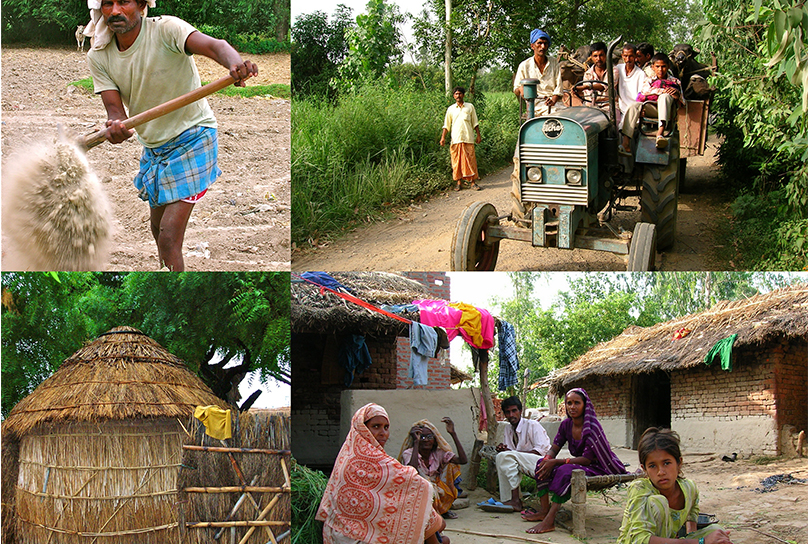
Harevli, Bijnor district
Harevli is a small village located in Najibabad block, Bijnor district, western Uttar Pradesh. At the time of our 2006 survey, 115 households and 674 persons were resident in the village. The dominant caste in the village was Tyagi. Dalit households constituted 38 percent of total households.
Although Harevli is a small village in terms of population, the area of land in the jurisdiction of Harevli village was large, about 505 hectares. A substantial part of the land was owned by residents of neighbouring villages and by persons belonging to the Tyagi caste who had migrated from Harevli to cities for salaried jobs or to set up businesses. Many of these non-resident landowners leased out their land for cultivation to the residents of Harevli.
On the other hand, about 33 percent of households in Harevli were landless, reflecting the unequal distribution of land in the village.
Sugarcane was the most important crop, and wheat, paddy and fodder crops were also cultivated. Irrigation from a public canal, part of the Eastern Ganga canal project, provided water during the kharif season. Tubewells (fitted with diesel or electric pumps) were used for additional irrigation, particularly in the rabi season. Most of the tubewells were owned by large landowning Tyagi households.
During the 2006 survey, there was no all-weather road to the village and the main means of transport from the village to Mandavli, the nearest town and about 4 km away, were bullock-cart and horse-cart.
There were 130 households in the village during the 2023 survey. The village was connected by an all-weather road. E-rickshaws were the primary public transport for the residents. Almost all households had access to electricity connections.
Mahatwar, Ballia district
Mahatwar village is located in Rasra tehsil, Ballia district, eastern Uttar Pradesh.
There are three agro-ecological areas in Ballia district. The tracts of the north, covering Belthara Road (Sear) and Sikandarpur tehsils, are irrigated by the Doharighat canal system. These areas also have groundwater irrigation. The major crops grown in these areas were paddy, maize, pigeon pea (arhar), wheat and gram. The eastern part of the district, known as Doaba, is a part of the Gangetic delta. The soil here is sandy and unsuitable for paddy cultivation. Maize, red gram and wheat were grown here. Although a part of this region is in the command area of the Surha canal system, very little irrigation water was received from it. In the west, the Rasra tehsil was almost entirely dependent on groundwater.
Mahatwar is located near the highway linking Rasra and Mau. At the time of the 2006 survey, there were 159 households and 1114 persons resident in the village. Mahatwar is a multi-caste village, with 10 different castes. Dalits accounted for 60 percent of all households. The dominant land-owning caste was Rajput.
Land distribution in the village was characterised by the prevalence of very small holdings. About 20 percent of the households in the village did not own agricultural land, and about 71 percent owned less than 1 acre each. Non-agricultural occupations, within and outside the village, provided an important source of income to resident households. The people of the village had access to bus and jeep services to nearby towns as well as to larger cities such as Varanasi.
The major crops grown in Mahatwar were rice during the kharif season and wheat (sometimes inter-cropped with mustard) during the rabi season. Irrigation was from groundwater, using tubewells powered by diesel or electricity.
During our 2023 survey, approximately 215 households were present in the village, out of which 107 were surveyed.
The Foundation conducted a workshop in February 2025 to discuss the results from surveys under the Project on Agrarian Relations in India. The workshop had scholars present their preliminary findings that explored various social and economic aspects of the survey villages. The workshop covered a wide range of topics, such as socio-economic differentiation in the villages, including the peasantry and workers, shifts in household incomes, changes in landownership patterns and mobility, the economics of farming, livestock economy, changing educational profiles, housing and living standards, and credit. The details of the workshop can be found here.
The following work was also published based on findings from the survey:
- Jens Lerche (2025), “Introduction to the Studies of Harevli and Mahatwar Villages,” Review of Agrarian Studies, vol. 15, no. 2. View the article.
- Kunal Munjal and Madhura Swaminathan (2025), “Agrarian Change in Uttar Pradesh: A Review of Village Studies,” Review of Agrarian Studies, vol. 15, no. 2. View the article.
- Niladri Sekhar Dhar (2025), “Socioeconomic Classes in Two Villages in Uttar Pradesh,” Review of Agrarian Studies, vol. 15, no. 2. View the article.
- V. K. Ramachandran and C. A. Sethu (2025), “Peasants and Proletarians in Harevli and Mahatwar,” Review of Agrarian Studies, vol. 15, no. 2. View the article.
- Deepak Johnson and Tapas Singh Modak (2025), “Economics of Farming in Mahatwar, Uttar Pradesh,” Review of Agrarian Studies, vol. 15, no. 2. View the article.
- Kunal Munjal (2025), “Cereal Production in the Sugarcane Belt Commercialisation and Smallholder Tenants in a Western UP Village,” Review of Agrarian Studies, vol. 15, no. 2. View the article.
- Niladri Sekhar Dhar and Kulvinder Singh (2025), “Patterns of Diversification in Rural Household Incomes: Evidence from a Longitudinal Study in Uttar Pradesh,” Review of Agrarian Studies, vol. 15, no. 2. View the article.
- Rithika Reddy and Madhura Swaminathan (2025), “Land and Income Mobility in Two North Indian Villages: A Note,” Review of Agrarian Studies, vol. 15, no. 2. View the article.
- Daya Susan Thomas and Madhura Swaminathan (2025), “Educational Achievements and Gaps: Insights from Longitudinal Village Studies in Uttar Pradesh,” Review of Agrarian Studies, vol. 15, no. 1. View the article.
- Ritam Dutta (2025), “Financial Inclusion from a Gender and Caste Perspective: Evidence from Two Villages in Uttar Pradesh,” Review of Agrarian Studies, vol. 15, no. 1. View the article.