This blogpost is an outcome of a research project on Digital Agriculture in India conducted by the Foundation for Agrarian Studies, and supported by the Rosa Luxemburg Stiftung.
Over the last decade, digital technologies have acquired a central place in the global agricultural policy discourse, as having the potential to transform agriculture by increasing the productivity and incomes of producers, along with advancing environmental sustainability. These technologies are expected to improve input-use efficiency, provide customised farming solutions, including inputs, information, credit, insurance, etc., and enhance efficient delivery of government schemes, and public and private services (El Bilali and Allahyari 2018; Klerkx et al. 2019; Schroeder et al. 2021). The belief in the promise of digital technologies is shared widely by multilateral organisations, research institutions, and policymakers (Klerkx et al. 2019; Cobby 2023).
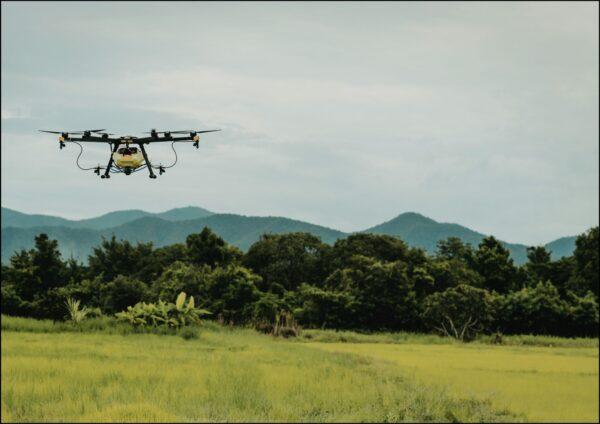
The Indian policy framework has been quick to adopt this discourse, which is reflected in a range of policy measures, including schemes focused on specific digital technologies, brought about by the Government of India (GoI), and several State governments (1). Indian agri-tech companies are also increasingly engaged in developing products and services that employ digital tools across the agricultural value chain – for seed traceability; trading and purchase of inputs on online platforms; application of inputs (pesticides, fertilisers, seeds, etc.) using unmanned aerial vehicles; delivering agro-advisories via Artificial Intelligence (AI)-enabled chatbots and mobile applications; irrigation with smart sensors, and so on (FAO and ICRISAT 2022) (2).
However, policy push and technological advancements alone are not sufficient, and the effective reach and widespread adoption of digital technologies in agricultural production in rural areas require certain pre-requisites – such as reliable access to digital infrastructure; digital literacy or the ability to use smartphones and the internet; and proficiency in performing basic information and communication technology (ICT) tasks – to be met. The fulfilment of these preconditions forms the ground for any successful realisation of the promise of digital agriculture. Based on our analysis of the unit-level data from the Comprehensive Modular Survey conducted by the National Sample Survey Office (NSSO) in 2025 as part of its 80th round, we attempt to assess the reality of the Indian countryside in terms of these preconditions. We also examine these issues along the axes of gender and social group.
Digital Infrastructure
Access to the internet is a primary requirement for the use of digital technologies. Findings from NSSO (2025) show that internet access among rural households in India is not universal. While 83 per cent of the households have reported access, only around 8 per cent reported the availability of a broadband connection (Table 1). An overwhelming majority of those with internet access were using it through mobile networks or cellular connections.

Although there is widespread use of the internet among rural households, large gaps persist at the level of individuals. Only around half of the rural adult population reported owning a smartphone and having internet access in their household (see Table 2). This proportion is less than two-thirds when access to or possession of a smartphone is taken into account.
The corresponding proportions are significantly lower for women in rural areas. Just a little more than a third of all adult women in rural areas reside in households with an internet connection, and own a smartphone as well. These numbers are striking, given the increasing role of women in agricultural production in India. Unsurprisingly, the figures for ownership of smartphones, and internet access are worse for men and women from disadvantaged social groups.
Digital Literacy
To examine the levels of digital literacy in rural India, we draw on the definition provided by the Dattopant Thengadi National Board for Workers Education and Development, Ministry of Labour and Employment, GoI. A digitally literate household was defined as one which has at least one member (aged 5 or above) who is able to use a computer and the internet. While NSSO (2025) data do not allow the assessment of digital literacy exactly as per this definition, it provides enough information to draw some meaningful inferences.
NSSO (2025) collects information on the ability to use the internet for both informational and entertainment (including communication) purposes. This information is gathered only from those individuals who report the use of either a mobile phone, smartphone, or computer (ICT device) in the last three months. It allows us to get a sense of digital literacy in the countryside.
Our analysis of the NSSO (2025) data shows that 96 per cent of the rural households had at least one member aged 5 or above who used an ICT device. Interestingly, only 11 per cent of these households reported having no member with the ability to use the internet, thereby depicting the increasing reach of ICT and internet in rural India. However, more than 25 per cent of households had no person who could use the internet for informational purposes (see Table 3). The absence of the ability to use the internet in an ICT device for informational purposes can be regarded as a mark of digital illiteracy, and more than a quarter of the rural households fall in this category.
Digital literacy among rural adults is worse (see Table 4). More than 80 per cent of the rural adult population reported using an ICT device. However, nearly half of these individuals also expressed an inability to use the internet for informational purposes. They can thus be regarded as digitally illiterate. Unsurprisingly, the levels of digital illiteracy were worse among women and socially marginalised groups (see Table 4).
Digital illiteracy would be even higher if the criterion included using computers (instead of mobile phones), as only 11 per cent of the rural adult population had ever used a computer.
Proficiency with Basic ICT Skills
Access to smartphones and digital literacy does not necessarily imply proficiency in the use of ICT tools. NSSO (2025) canvasses a few questions that allow assessing proficiency in what can be regarded as basic ICT skills. We provide some illustrations of proficiency based on the analysis of rural individuals’ access to smartphones and their ability to send messages, capacity to execute online transactions, or awareness of the procedures for reporting a cybercrime on an online portal. The proportion of rural adults who reported both having access to smartphones and being able to send messages with an attachment was 55 per cent; meaning almost half of the adult population in rural India cannot perform a very basic digital task (see Table 5). This proportion declines to 40 per cent, and, to a mere, 12 per cent when we consider the criteria of executing online transactions and reporting a cybercrime, respectively. The corresponding figures for rural adult women were even lower. Less than 8 per cent of rural adult women had access to smartphones and also had the ability to report a cybercrime.
Concluding Remarks
Our analysis of unit-level data from NSSO (2025) shows that the prerequisites for a digital transformation of agriculture – reliable internet, ownership or access to smartphones, digital literacy, and proficiency in performing basic ICT tasks, in rural India, are far from universal. Even in cases where access to smartphones and the internet is better, significant proportions of the rural population lack the ability to use them for productive purposes, or the execution of basic ICT tasks.
Rural women fare much worse than rural men in all these aspects (3). This raises a critical policy concern as women are increasingly engaged in agriculture and allied activities. Further, if digital technologies emerge as primary vehicles for the delivery of information, services, and products, large sections of the population may be left out.
The productive potential of digital agriculture, and its equitable distribution, can be achieved only if these necessary preconditions are met. There is therefore an urgent need to expand investments in digital infrastructure, focus on developing digital skills of the population, particularly women and disadvantaged social groups in rural areas. This focus must become part of policy thinking on digital agriculture.
Acknowledgement
We thank Professor Madhura Swaminathan for her comments on an earlier draft, and Nikita Gupta for her editing inputs.
Notes
(1) In 2024, the Digital Agriculture Mission (DAM) was launched by the Government of India (GoI) as an umbrella scheme to support all digital initiatives in the agriculture sector. It aims to develop a “farmer-centric” digital ecosystem for agriculture that can be used by public and private entities to develop and/or deliver highly customised products and services. More recently, GoI launched Bharat-VISTAAR (Virtually Integrated System to Access Agricultural Resources), an AI-enabled tool which can provide customised advisories to farmers. Major government schemes and services such as Pradhan Mantri Fasal Bima Yojana (PMFBY) have integrated digital tools across a range of functions, such as real-time monitoring and tracking, online registrations, and so on.
(2) Most of these technologies are still at an experimental stage in India (World Economic Forum 2025; Bhuvaneshwari and Kumar 2025), although some level of adoption has been reported in the case of unmanned aerial vehicles (UAV)/drones in agriculture (Belton et al. 2025; Kotu et al. 2025).
(3) The gender gap observed in the possession of digital skills, and the ownership and use of smartphones is not limited to rural areas. The prevalence of these gaps across the country, including rural and urban areas, was recently highlighted by Tewari (2025) in an article.
References
(1) Belton, Ben, Baldiga, Leo, Justice, Scott, Minten, Bart, Narayanan, Sudha, and Reardon, Thomas (2025), “Can the Global Drone Revolution Make Agriculture More Sustainable?” Science, vol. 389, no. 6764, pp. 972–76.
(2) Bhuvaneshwari, T. H., and Kumar, P. (2025), “Digital Inclusion for Rural Transformation: A Double Hurdle Analysis of IoT Sensor Adoption Among Grape Farmers in India,” Indian Journal of Agricultural Economics, vol. 80, no. 3, pp. 650–70.
(3) Cobby, Roy W. (2023), Digital Agriculture in India: A New Green Revolution? PhD thesis, Department of Digital Humanities, King’s College London, London.
(4) El Bilali, H., and Allahyari, M. S. (2018), “Transition Towards Sustainability in Agriculture and Food Systems: Role of Information and Communication Technologies,” Information Processing in Agriculture, vol. 5, no. 4, pp.456–64.
(5) Food and Agriculture Organization (FAO) and International Crops Research Institute for the Semi-Arid Tropics (ICRISAT) (2022), Digital Agriculture in Action: Selected Case Studies from India (Country Investment Highlights No. 17), FAO.
(6) GoI and World Economic Forum (WEF) (2025), Future Farming in India: A Playbook for Scaling Artificial Intelligence in Agriculture, Ministry of Electronics and Information (GoI) and WEF, available at https://reports.weforum.org/docs/WEF_Future_Farming_in_India_A_Playbook_for_Scaling_Artificial_Intelligence_in_Agriculture_2025.pdf, viewed on March 3, 2026.
(7) Klerkx, L., Jakku, E., and Labarthe, P. (2019), “A Review of Social Science on Digital Agriculture, Smart Farming and Agriculture 4.0: New Contributions and a Future Research Agenda,” NJAS-Wageningen Journal of Life Sciences, vol. 90, p. 100315.
(8) Kotu, S. C., Maurya, N., Baksi, S., Modak, T. S., and Pulagiri, R. (2025), “Diffusion and Scaling Up of Drones in Agriculture: A Case Study of Nalgonda District in Telangana,” Paper presented at the “International Conference on Agrarian Change,” Foundation for Agrarian Studies, Thiruvananthapuram, India.
(9) National Sample Survey Office (NSSO) (2025), Comprehensive Modular Survey on Telecom–NSS 80th Round: 2025, Ministry of Statistics and Programme Implementation, Government of India (GoI), New Delhi.
(10) Schroeder, Kateryna, Lampietti, Julian, and Elabed, Ghada (2021), What’s Cooking: Digital Transformation of the Agrifood System, World Bank, Washington, D. C.
(11) Tewari, S. (2025), “Why India Needs to Urgently Address Gender Gap in Digital Skills,” IndiaSpend, Jun 21, available at https://www.indiaspend.com/gendercheck/why-india-needs-to-urgently-address-gender-gap-in-digital-skills-957650, viewed on March 3, 2026.